
Acyl Halides



Medchemexpress LLC N-Heptanoyl-DL-homos | 213.27 g/mol | C11H19NO3 | 10MG

N-Heptanoyl-DL-homoserine lactone is a serine derivative[1]

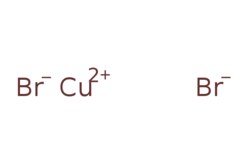
eMolecules 7789-45-9 | Copper(II) bromide, 99% | Strem Chemicals | MFCD00010970 | 223.354 | Br2Cu | 99.000 | [Cu++].[Br-].[Br-] | 250g | 321342129
Copper(II) bromide, 99% | Strem Chemicals | 7789-45-9 | MFCD00010970 | 223.354 | Br2Cu | 99.000 | [Cu++].[Br-].[Br-] | 250g | 321342129
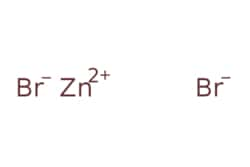
eMolecules 7699-45-8 | Zinc bromide | Oakwood Chemicals | MFCD00011294 | 225.190 | Br2Zn | 98.000 | [Zn++].[Br-].[Br-] | 25g | 480169582
Zinc bromide | Oakwood Chemicals | 7699-45-8 | MFCD00011294 | 225.190 | Br2Zn | 98.000 | [Zn++].[Br-].[Br-] | 25g | 480169582

Cambridge Isotope Laboratories 1-Palmitoyl-2-lyso-SN-glycero-3-phosphoglycerol NH4 (palmitoyl-D31 97% 50-60% on Alpha carbon) 0 1 g
1-Palmitoyl-2-lyso-SN-glycero-3-phosphoglycerol NH4 (palmitoyl-D31 97% 50-60% on Alpha carbon) 0 1 g

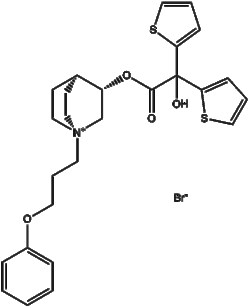
Apexbio Technology LLC Aclidinium Bromide 320345-99-1 5mg
Aclidinium Bromide (CAS 320345-99-1) is a long-acting muscarinic antagonist (LAMA) that selectively inhibits muscarinic acetylcholine receptors In binding assays it demonstrates high affinity for M1 M5 receptor subtypes with Ki values of 0 10 0 21 nM Functional studies reveal greater potency at endogenous M2 and M3 receptors with EC50 values of 17 4 nM and 5 3 nM respectively In vivo aclidinium bromide produces a concentration-dependent inhibition of acetylcholine-induced bronchoconstriction (EC50 2 5 23 1 g/mL in anesthetized guinea pigs) and suppresses pilocarpine-induced salivation in rats (EC50 38 g/kg) This compound is widely utilized in respiratory research for evaluating airway smooth muscle modulation via muscarinic receptor antagonism
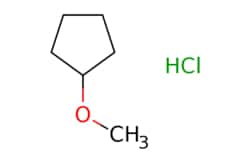
eMolecules 7647-01-0 | Hydrogen chloride solution 3.0M in cyclopentyl methyl ether (CPME) | Oakwood Chemicals136.620 | C6H13ClO | 0.000 | Cl.COC1CCCC1 | 25g | 480145793
Hydrogen chloride solution 3.0M in cyclopentyl methyl ether (CPME) | Oakwood Chemicals | 7647-01-0136.620 | C6H13ClO | 0.000 | Cl.COC1CCCC1 | 25g | 480145793
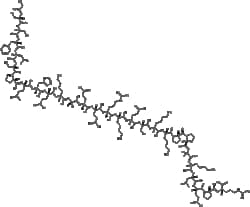
Apexbio Technology LLC [Des-octanoyl]-Ghrelin (rat) 307950-60-3 1mg
Des-octanoyl-Ghrelin (rat) is a desacylated peptide derivative lacking the octanoyl modification present in ghrelin resulting in decreased affinity for the growth hormone secretagogue receptor type 1a (GHS-R1a) It modulates metabolic processes such as energy homeostasis glucose regulation insulin sensitivity and lipid metabolism primarily through alternative receptor-mediated pathways Des-octanoyl-Ghrelin (rat) exerts its biological activity via modulation of endocrine regulation and inflammatory responses Based on these pharmacological properties Des-octanoyl-Ghrelin (rat) holds research potential in studies of appetite control metabolic disorders and elucidating signaling pathways linked to metabolism-related diseases
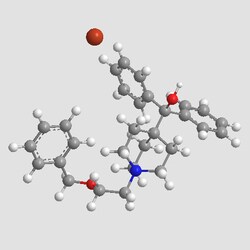
Apexbio Technology LLC Umeclidinium bromide 869113-09-7 2mg
Umeclidinium bromide (CAS 869113-09-7) is a potent and long-acting antagonist of muscarinic acetylcholine receptors (mAChRs) displaying high affinity for subtypes M1 M5 with Ki values of 0 16 nM 0 15 nM 0 06 nM 0 05 nM and 0 13 nM respectively It selectively targets mAChRs without observable activity at unrelated receptors or channels such as / opioid receptors sodium channels or dopamine transporters In cell-based assays using CHO cells expressing recombinant human mAChRs umeclidinium inhibits acetylcholine-induced calcium flux with pA2 values between 9 6 and 10 6 for M1 M3 receptors In murine models it reverses acetylcholine-driven bronchoconstriction Umeclidinium bromide is broadly applied in research focused on pulmonary disease mechanisms and drug development

Apexbio Technology LLC Ipratropium Bromide 22254-24-6 10mM (in 1mL DMSO)
Ipratropium bromide (CAS 22254-24-6) is a synthetic quaternary ammonium compound structurally derived from atropine It functions as a muscarinic acetylcholine receptor (mAChR) antagonist primarily inhibiting M3 receptor-mediated bronchoconstriction in airway smooth muscle By blocking parasympathetic-mediated bronchial smooth muscle contraction it induces bronchodilation Ipratropium bromide is widely utilized in research to investigate cholinergic signaling pathways airway physiology and the pharmacological modulation of bronchomotor tone Its properties make it valuable for studies focused on obstructive pulmonary conditions and respiratory drug development

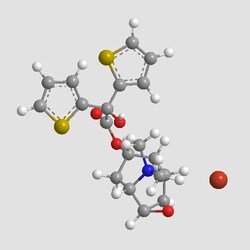
Apexbio Technology LLC Tiotropium Bromide 136310-93-5 10mM (in 1mL DMSO)
Tiotropium Bromide (CAS 136310-93-5) is a potent antagonist of muscarinic acetylcholine receptors (mAChRs) By competitively inhibiting acetylcholine binding at these receptors it prevents receptor activation and subsequent signaling cascades leading to decreased neuronal transmission and smooth muscle relaxation As a long-acting anticholinergic bronchodilator with activity lasting approximately 24 hours Tiotropium Bromide is widely studied in managing chronic obstructive pulmonary disease (COPD) including cases complicated by chronic heart failure
eMolecules 7699-45-8 | Zinc bromide | Oakwood Chemicals | MFCD00011294 | 225.190 | Br2Zn | 98.000 | [Zn++].[Br-].[Br-] | 100g | 480169583
Zinc bromide | Oakwood Chemicals | 7699-45-8 | MFCD00011294 | 225.190 | Br2Zn | 98.000 | [Zn++].[Br-].[Br-] | 100g | 480169583
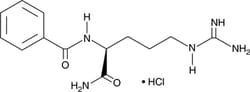
Cayman Chemical N-α-Benzoyl-L-Argininamide (hydrochloride), Purity: ≥98%, CAS: 4299-03-0, 1 g
A nonpeptide substrate of proteases and deiminases; has been used as a substrate for the quantification of papain, carboxypeptidase B, PAD2, and PAD4 activities
Medchemexpress LLC Aclidinium (Bromide) | 320345-99-1 | 98.96% | C26H30BrNO4S2 | 50 MG
Aclidinium Bromide is a long-acting, inhaled muscarinic antagonist. It is for research use only and has potential for chronic obstructive pulmonary disease (COPD) research. The product is not sold to patients and has not been fully validated for medical applications.
- Long-acting muscarinic antagonist
- Potential for chronic obstructive pulmonary disease (COPD) research
- Sustained bronchodilation suggested by M3 and M2 receptor residence times
- Low systemic bioavailability and favorable safety profile confirmed in studies
Medchemexpress LLC Palmitoyl tetrapeptide-10 | 887140-79-6 | 99.5% | 761.05 | 10 MG
Palmitoyl tetrapeptide-10 is a bioactive peptide that works synergistically with other active ingredients to increase the expression of corneodesmosin (a marker of keratinocyte adhesion) and filaggrin (a marker of keratinocyte terminal differentiation). This action helps in reducing skin permeability and improving skin barrier function. It can be used in the research of sensitive skin syndrome and skin pigmentation.
- Increases expression of corneodesmosin
- Increases expression of filaggrin
- Reduces skin permeability
- Improves skin barrier function
- Suitable for research on sensitive skin syndrome
- Suitable for research on skin pigmentation